Showing posts with label Supernatural Horror. Show all posts

Monday, 18 March 2013

Montage


Source of Inspiration: Montage Sequences

We came across some trouble when originally planning our death scene and chose to leave the murder vague within our storyboard as to refer back and add in detail as we began to produce the piece.

We found it would be difficult to incorporate supernatural elements into our death without any expertise in special effects or skilled acting so we therefore decided it would be best for the killing to occur off screen, adding an air of mystery to our plot as an unnatural inhuman event, allowing our audience to themselves envision what they believe to have happened.

To accompany this idea, I looked into montage sequences used in other horror films to disorientate the viewer. We decided that by compiling a number of shots related to the plot context and of gruesome images would allow us to maintain an uncomfortable experience for the audience and to enforce fear due to their lack of understanding and the fast pace of the transition between shots.

After having storyboarded ideas we chose to include shots of:
  • The clown (at different proximities, moving farther away from the camera and then appearing at an awkward and incredibly intimate distance to finish)
  • Various violent weapons (a crowbar, the blade of a saw and a hammer struck towards the camera)
  • Victim (having his neck snapped shot at different angles and lying dead upon the floor)
  • Disgusting images (maggots, rotten apples)
  • Point of view shots to mimic a victim running to escape (through the tunnel and up the stairs)
  • Repetition of previously used skyline shots to refer back to the isolation anonymous London location (edited to appear with a newly green trint to represent the supernaturtal elements of the city now apparent)

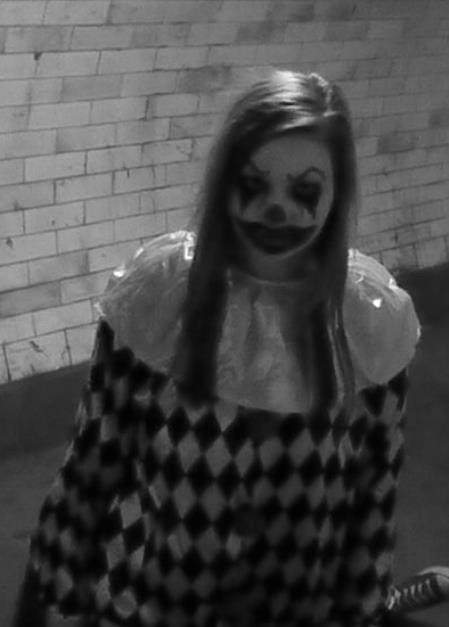
Final Costume


During the filming process, our original costume plan was altered due to issues with filming and availability.
  • Originally we had planned to include a dark suit for the antagonist of red and black to connote both danger and the spilling of blood but due to filming difficulties we chose to opt for a white and black outfit with red elements. This worked better for us due to it's visibility, enabling the clown to be seen more easily in the dark due to the lack of lighting available on location.
  • We also planned to spray the clown's hair green but due to the dark lighting of our location and the use of black and white CCTV filter in the tunnel, the colouring would have been barely visible and so therefore we chose not to include this colouring. 
  • The original face paint chosen was also altered for filming purposes, blood was added dripping from the eyes and the black around them was made larger, drawing attention towards the darkness and the unnatural features of the clowns face as to make it appear more sinister.
  • Also, we originally intended to use red contact lenses to convey supernatural inhuman elements but found again, like the hair colouring, it would have very little impact on overall shots. We also made this decision as the large quantity of red already intended in each of our shots would have caused the majority of the mise en scene to suggest bloodshed, which isn't used within this particular scene. The contrast of the pale blue eyes against the dark black and red features of the face paint also created a more startling affect, as they seem far more prominent and chilling as they stare into the camera in close up shots.

Sunday, 24 February 2013

Chimes

In order to get the sound for the 3 clips I recorded one of my old Globes that play nursery rhymes when wound up and left to play. I recorded it on my phone and the quality came out really well and therefore I didn't need to re-record it again. I found that it was very creepy and also when edited it came out really well. I used the software called Audacity in order to change the effects on the music which is an online free piece of software. 

Backwards Melody

For the backwards melody I put the song into Audacity and the highlighted the entire piece of music and then picked a effect from the top tool bar that would put the song into reverse. I found the tool and then selected it before listening back to it. It turned out really well and the sound is really distorted without over editing it too much and losing the sounds quality and scariness. I therefore left it with just the reverse as the edit that I did to it and therefore this meant that the sound was constantly pulling itself backwards and it sounds really awkward to listen to back. 


Slow Melody

With the slow melody I chose the effect which changed the speed of the piece of music. I pulled the slider to the left and therefore this made the piece of music go much slower. I did like it however it lost the scariness through removing the fastness and therefore I wasn't so keen on how it sounded after listening to it. I didn't do anything else to it as I didn't want to carry on this piece of music as it is too slow for the opening in which we are doing. It also doesn't sound as menacing as the others and therefore I decided to leave it rather than make it even worse. 

Fast Melody

This is my favourite one because I really like how speeding up the clip has made it more mysterious and spooky rather than just a normal nursery rhyme which although is quite scary was fast paced enough for the opening which we are putting together. Therefore I really found that by just changing the speed alone made the music much more suitable for the opening and therefore made no other changes to it overall. I did try adding an echo but that made it too over crowded with noise and therefore abandoned that idea as it didn't work out. I also tried bass but as the pitch is too high this was pretty much useless and therefore left that idea. It is much more effective with the simple adding speed to it rather than over doing it with more effects than it actually needs. 

Sunday, 10 February 2013

Production Companies


1. Hammer Films
'Smart Horror'
Let Me In, Woman in Black, The Resident, Wakewood.


2.Big Talk Productions
Largely Comedy-Horror
In Fear, Hot Fuzz, Shaun of the Dead, Attack the Block

3. Lionsgate Entertainment
All Genres
The Last Exorcism, Cabin in the Woods, Haunting in Connecticut, Saw


4.BBC Films
Tormented, Fish Tank, The Awakening


5.Twisted Pictures
Saw, Dead Silence, Texas Chainsaw 3D


6. Ghosthouse Pictures
Drag Me To Hell, The Possession, The Grudge
    Produces horror thrillers, largely in the supernatural genre (usually focusing on possessions).

      Monday, 28 January 2013

      Changes to Filming

      On location, we discovered that there were problems with some of the original decided features of our scene:
      • When filming our test shots, it became apparent that the path we had originally chosen for the victim to follow around the Royal Naval College into the foot-tunnel would cause difficulties. We had to block out a separate route through the grounds ensuring that no restaurants, passing visitors, sign posts for the gift shop or shots in which the glass casing of the Cutty Sark were visible. This proved difficult due to the lack of lighting upon the foot-paths in the area and the obvious commercialisation of the location.
      • On our original storyboard, no filming was included from the individual view of the victim as we decided to film the majority in CCTV format due to no intended empathy being felt towards the victim as an emotional bond between them and the audience as their character is insignificant as part of the plot.
      • The skyline shots we are using within our scene originally were not planned and were added as a decision during filming. We had planned to include establishing shots to determine the importance of our location as an anonymous city (London) but originally of the college and Cutty Sark itself but on location, we found the brighter and more definitive example of London as a location would have been better represented using the skyline shot of the City buildings across the Thames as a universal symbol.
      • Our first plan depicted the entirity of the scene filmed in the tunnel to be produced in black and white as CCTV footage but due to the supernaturality of our plot and our intention to emphasise this, we can now chosen to switch between colour during these shots to distort the image.


      Tuesday, 22 January 2013

      Name Choices

       The Naming Process

       To begin progress within deciding on a name for our film, I began with making a list of the main components of our scene, a technique that would allow names to be thought up due to what is included within our piece. 
      However, it is difficult to decide upon a definitive name due to certain features of our opening (such as location) due to the following plot not to have been decided in depth. For example, as we are only producing the opening scene in which a murder takes part in a tunnel we could in theory title it around this feature but if the film were to continue and be produced following on from this scene, it is not initially intended for the majority of the setting to be placed in that tunnel.

      Whilst brainstorming choices, I included all possible titles I came up with despite a number of them being useless due to sounding terrible and having other issues so that when shown to the rest of the group presenting the ideas, it can allow us to critique different choices and possibly come up with more ideas related to them.

      At the current stage of process, the three most effective choice (in my opinion) would be; 'Grin.', 'Whiteface' and 'Smile, Please.' as having as few syllables as possible allows the name to be short and memorable .
      • Grin refers to the clown's face itself and also towards the lipstick mark they leave upon their victim acting as a calling card.
      • Whiteface is the name of the type of clown we are using within our scene as the antagonist, a comedy grotesque whiteface. (Allows us to enforce to the audience that the clown itself is the focus, not the victim or location.)
      • 'Smile, please' also refers to the calling card mark left upon the victim's body after the murder has taken place. (Conveys a sinister tone, typically a possible title choice for a comedy film.) 

      Monday, 14 January 2013

      Editing Choices


      Shot One- Rolling Credits
      Applying a bleach bypass effect
      Increased speed up to four times it's original pace


      Shot Two- London skyline
      Applied bleach bypass effect
      Speed increased by half


      Shot Three- London Skyline
      Speed increased four times
      Reduced Motion Distortion
      Increased zoom by 7%
      Smoothed stability

       Shot Five- London Skyline

      Increased zoom by 16%
      Smoothed stability
      Reduced motion distortion


      We wanted to increase the speed at the beginning to shock the audience and set the a fast pace for our opening. We sped up the clip duration to enable us to fit in more shots and we liked the resulting effect. By speeding up the start, the audience have no idea what is going on, which is our intention, as we wanted the audience to be confused and disorientated. By using the tunnel shots, it allowed a smooth movement going through the tunnel and established the location.


      When we applied the bleach bypass, we wanted an effect that darkened the tunnel and created a dirtier more sinister horror effect, as it complemented the surroundings and created shadows on the walls, in which would interest the audience to what unusual events are occuring within the tunnel.


      When editing the skyline, we decided to stabilise the establishing shot, as we did not want it to jolt. Our intention was for the establishing shot to be a serene shot, in contrast to the tunnel opening it follows. The shot included London lit-up at night and we increased the contrast to enable the audience to be able to establish the buildings in the shot, and connect it with London. The motion distortion was needed to enable the smooth movement, as when it was first shot, it was taken through shaken hands, which post-filming we decided wasn't an effect we felt appropriate for this shot.

      Monday, 7 January 2013

      Evaluation of Practical Progress So Far

      Our Visit to Location

      • When we took our first visit as a group to visit our location and started test shooting to ensure when it came to post-production, we would not be faced with having to refilm sections due to lighting and other issues that may occur.
      • We established in which order and when we would film certain shots, scheduling them in sections and in order of importance.
      • Also, we blocked out where and how the camera/actors would move, altering our original decisions due to what was more easily achievable and effective within our choice of location.
      • One of our changes made was to attach our camera onto the top of a bicycle to enable smooth, steady movement when the camera follows the actor's path.
      • We were also able to establish where we would chose to film our opening shots to establish the region and background to our plot.
      • In terms of costume, our visits also confirmed to us that the antagonist being dressed in white and red would be far more affective in terms of visibility due to the lighting available to us (allowing us to choose a final costume).
      • By the finish of our first visit, we'd made effecient progress in determining exactly how we would film and also it enabled us to discover what we would need to negotiate and compromise in future, therefore allowing us to plan our next visit.

      Monday, 17 December 2012

      Unseen/Seen Entities


      This trailer uses both seen and unseen entities. 
      The part of this trailer that shows an unseen entity is the scene with the rocking horse.


      This scene is really effective because we begin to wonder what is rocking the rocking horse. Also, the fact that we cannot see what is doing this, puts nearly all of our focus on the sound. 
      Seen as sound is very important in horror films, it makes sense to put a lot of the focus on it.


      Pros of using an unseen entity;

      • No need for an extra actor
      • More focus on easier things; ie sound
      • Seems more eerie
      • No special effects/makeup etc needed
      • Possibly scarier as we cannot see what is causing all of the problems 
      Cons of using an unseen entity;
      • Can look tacky
      • Difficult to be different from other films 
      • If the sound isn't perfect then it would not have the same effect


      However, this trailer does also have a see entity.


      Although it's effective to have all of our focus on sound, I think that this is also a perfect example for why we should use a seen entity. 
      Generally, it's the surprise element that makes it much more exciting. In a supernatural horror, we do not expect to see the thing causing all of the problems and, when we are faced with this, we are surprised.

      Pros of using a seen entity;

      • Surprise factor
      • Chance to do something completely different and new
      • Effective without sound
      Cons of using a seen entity;
      • Hard work to think of a new idea
      • Makeup could be problematic 
      • Having to rely on another actor could cause further problems 
      • Once the audience has seen the killer once, it might not be as scary after that

      Sunday, 9 December 2012

      Supernatural Deconstruction


      Mise en scene


      • The figure that we can see is just a silhouette and this adds to the mystery of the shot because we, as the audience, do not know who (or what) this is. 
      • Going with the wooden wall and the rags that are on the left side of the shot, we can guess that this is quite an old house.
      • The way that the right side of the shot is much neater than the left suggests that there may be two types of people in this house. It could be showing the different personalities of those in the house.
      • Depth of field with this shot is particularly deep. This allows us to take in the surroundings and the shadowed figure.
      • The dominant in this shot is clearly the silhouette as it is the only thing blocking the light.
      Sound
      • During this particular part of the scene, there is a non-diegetic burst of sound when the character begins to move. This sounds like a short and sharp high pitched note. It adds a lot of tension to the scene and makes us jump a little.
      • The only other sound in this scene is the, rather scared, voices of the two teenage boys who have wondered into this house.
      Lighting
      • The main source of light is coming from behind the character in this shot and I think that it is effective because it makes the shadowed man look more mysterious.
      • The lighting also highlights a mist of some sort, adding the paranormal twist.
      • There is no lighting coming from the other side of the character so it makes the whole shot look incredibly dark and this makes us feel a bit uneasy as we cannot see much of what else is in the shot.
      Editing
      • There is continuous cross-cutting to connect the two boys and the shadow figure.


      Mise en scene
      • The depth of field with this shot is quite shallow in contrast to the one before. The camera is focused on the two torsos that we can see.
      • One odd thing about this shot is that the man has his fist through the boy's body, but there is no blood coming from the hole. Yet, we still sense the danger.
      • The boy's shirt is a dark blue, which could usually connote masculinity but if we look closer, we can see the lines crossing over. 
      • This suggests that he probably isn't as masculine as he thinks.
      • Although we cannot see the man in the dark jacket, we can assume that he has a lot of power as he is being filmed from a low angle. 
      • This clearly shows that he is of a higher status than the teenagers.
      • There is a lot of black in this shot, mostly coming from the colour of the man's suit jacket, and black connotes suffering. This is supported by what's actually going on in the scene.
      Sound
      • There is an overlaying non-diegetic tune in the part of the scene. The tune is long and chromatic notes all of a higher pitch. 
      • This adds huge amounts of tension to the scene and shows just how much danger these boys are in now.
      • The only other sound in this scene is the gargling of the two boys.
      • Towards the end of this part, we can hear the blood dripping onto the floor.
      Lighting
      • The lighting in this shot makes the man in the suit jacket look a lot darker than the two boys. 
      • This clearly sets him apart from the other two characters. Making him more mysterious.


      Mise en scene
      • This is a close up of the man's face who has just killed the two teenage boys.
      • His eyes are incredibly dark, even the iris. This shows that he is evil from the inside as eyes are believed to be 'windows to the soul'.
      • By making his eyes dark, it also means that we cannot connect with the character, making us feel uncomfortable as we then can't figure out what his next move will be.
      • It is obvious that this man is well kept, which suggests that he comes from a well-off family. We can tell this because his mustache is well trimmed and he appears to be wearing a shirt and suit jacket.
      • With concerns to depth of field, it is incredibly shallow. We cannot see anything else in this shot apart from the man's face. This adds to his importance as a character and promotes his power.
      Sound
      • The only sound around this shot is the diegetic conversation between him and Dexter. 
      • With this being the only sound, we are able to tell that what we are hearing is very important.
      • Also, the lack of non-diegetic sound adds a lot of tension because we are then waiting for something to happen.
      Lighting
      • There is very little lighting in this scene and what lighting there is, there is a blue tint to.
      • This blue tint makes the scene a lot colder, connoting that this man may be cold hearted. 


      Mise en scene
      • The way that the man's eye colour and the colour of the strange light coming our of the other man's head are exactly the same, shows that they are linked. 
      • It shows that the man in the suit is clearly controlling whatever it is that is going on.
      • The purple on the man's suit shows individuality and sets him apart. This may be due to his extreme methods of punishment.
      • Also, even though the man on the right of the shot is much brighter, the man in the suit is still the dominant. This is because he is placed almost in the middle of the shot. All of this shows that he is definitely the most important person in this shot.
      • The man's suit is all perfect except for his tie. His tie is not straight and this tells us that something is not right with this man. That he may be perfect in nearly every way, but something about him is not right.
      Sound
      • There is a diegetic sucking sound when the man in the suit touched Dexter. 
      • This sound gives us the idea that he may be taking the energy (the bright light) for himself.
      Lighting
      • All of the lighting in this shot is coming off of Dexter and this illuminates the whole shot.

      Sunday, 18 November 2012

      Grave Encounters - Lighting


      • The lighting here looks like it is coming from a camera source or from a ver large torch light. This helps to create a lot of dark spots in the shot, adding tension to the scene.
      • The way that the light is so strong also helps to completely black out the windows. By blacking out the windows, it gives the impression that there will be no way out.
                                
      • Here, the lighting is illuminating quite a lot of the wall, especially on the right of the shot. However, this does not make the shot any less eerie.
      • The way that this shot is pretty much balck and white adds to our sense of insecurity because it makes it harder to distinguish between shadows and the dark.
      • At the every end of the corridor, the lighting makes it look like there is a shadow, implying that there may be something/someone there.
      • Seen as we cannot see whatever it is that is there, we are put on the edge of our seat, just waiting for something.
      • In this shot, there is quite a bit of lighting, which seems odd as it is meant to be a horror. However, I do think that the lighting here makes the shot even more eerie because the camera image is quite distorted.
      • The lighting here also helps to eliminate any shadows in the shot. This adds to the suspense because we are just expecting something to jump out of nowhere. 
      • This shot is different because it shows the lighting coming from a light on top of the camera. I think that this is different because it adds the, almost, circular effect to the light. This acts like a spotlight.
      • Another interesting thing about this shot is that it is slightly green. This green tint connotes that something is not right as it is an 'off' colour that we usually associate with someone being ill.
      • I found this shot really interesting because it is a close up of a man, but the light only illuminates one side of his face.
      • This shows that, although he may be talking to the camera and saying one thing, one half of him is concentrated on something else. Something darker maybe?
      • It also helps to show the flaws on this mans face. It highlights the bags under his eyes and the worry lines on his forehead. This all brings us closer to the character as we are at quite a personal, though quite uncomfortable, distance.
      These two shots both have the same colour tint to them. I found this quite interesting as it links the two shots together, even though they are in different parts of the trailer.
      The slightly green tint, that looks a bit like night vision cameras, adds to the tension of the trailer overall as the places that the light isn't hitting are really quite dark.

      Weeping Angels

      The Weeping Angels
      Dont Blink Episode


      (from 3.47 minutes)


      'Dont Blink'


      Camera Angle
      • The camera angle for the first shot is a wide angle which is at a low angle in order to give the angel more power over the people in the room. Also by having a wide angle it allows more of the angel to cover the screen and therefore makes it look more bigger; adding to the idea that it is powerful.
      • In the two shots below it the scene has become much more tighter and therefore in the bottom screenshot the scene is at its tightest as this is as close as the angel gets to his face. By having a tight scene it means that it reduces the amount of space the man has in order to escape.
      • In the bottom shot it is again filmed at a low angle and the angel takes up the majority of the shot. This then shows that the angel is bigger and more dominating than the man otherwise it would be the other way round.
      Sound
      • Whenever the angel moves and when the first stare at it there is the non diegetic sound of a clap of thunder or something similar in order to indicate that the angel is present and also a clap of thunder makes people jump and therefore by combining the shot and the sound, this scene is clearly made to make the audience jump.
      • There is also the diegetic sound of the man shouting out to the other female character in the scene. By having him shouting it shows his fear more; this will have effect on the audience.
      Editing
      • They use jump cut editing in order to make it scary which is shown through when he looks away and then looks back and it has moved closer towards his face.
      • This is combined with Stop Motion editing which how the angel changes as it gets closer towards the people. For example moving the arms and changing the expression on the face in between each shot.
      Mise En Scene
      • It is Low Key lighting and this therefore makes it a more scary atmosphere as in the top screen shot the angels face is less lit up and in the bottom screenshot you can see the entire face.
      • The angel doesn't have any pupils as this therefore makes them more sinister as it takes away the one part of the eye that allows to have connection with another person. It also foreshadows the idea that the human eyes blinking is their form of movement.
      • The man is more lit up that the angel and this therefore shows that he is more angelic than the actual angel.
      • The angel is subverting its convention as by being something un innocent and dangerous does not conform to what angels are perceived to be like.
      • The angels are grey and not white and this could mean that they are tainted by some sort of evil.
      • In the second screen shot the man is in a short depth of field which traps him with the angel and also more into the scene. Even though the door is in the background, by having it out of focus it shows that it is no longer a option for him to escape. 
      • In the top screen shot the director has used the idea of illusion and perspective in order to make the angels arm seem that it is coming out further than the audience may think. This also brings the angel into a more personal distance with the audience.
      • The man and the angel are both placed in the middle of the scene in order to show that they both have importance.
      • In the top screen shot the angel is looking down on the audience and this shows its dominance and also its height.


      'The only psychopaths in the universe to kill you nicely'


      Camera Angles 
      • The camera angles which have the angels in are much more looser and therefore this shows that the angels have room to move and get away if they needed to. It is filmed on a wide angel shot in order to not only fit in the entire angel but this also gives them size and make them more dominating over the people in the shots.
      • The people on the other hand are in tighter frames and this shows that they are trapped within the scene. Even in the fourth screenshot although they are in a loose frame, by having the angels placed around them in equal space it therefore makes them put into a tight frame by using the characters around them. This shows that framing doesn't entirely rely on the camera. 
      • The angels are filmed from higher angles whereas the people are filmed on level with their eyes and this therefore makes the audience feel like they are on their level.
      Sound
      • There is the diegetic sound of the human characters talking within the scene and interacting not only with each other but also with the angels although they cannot talk back.
      • There is also eery music playing in the background over the top of the dialogue which fits in not only with her situation but also with the location being in the dark basement.
      • When the fourth angel arrives there is swooshing/swooping sound which signals its arrival. 
      • There is also the diegetic sound of the light bulb flickering on and off in order to signal that they are turning the lights off so that they can move. 
      Editing
      • Stop Motion is used in order to create the angels movement from the previous room to the basement. 
      • Continuity editing in order to show the movement of time going forward.
      • Jump cut between the people and the angel.
      Mise En Scene
      • Again there is the low key lighting which conforms to the idea of them being in a basement and that basements are usually places used in order to create jumpy/scenes of horror for the audience. Nothing ever goes right in the basement.
      • The angel is made to look quite child like and this therefore makes it more scary how this angel which looks child like can turn into the monster that is shown in the previous scene.
      • The female character refers to angels as 'BOYS' when they are made to look like girls and this therefore creates some slight confusion. 
      • Although there is only one light in the room, each angel is in a pool of light as though when the lights are turned on they are harmless. Also the Tardis is nearly covered in complete darkness so the light may also be being used in order to highlight the danger around them.
      • In the third screen shot it looks like the angel is pointing at the audience and this therefore makes a connection between us and them and this may have been done in order to make the viewer believe that these angels could be real. Playing with the mind.  
      • By having the angel and the light bulb in the same shot it informs the viewer that the angel is controlling the light bulb. 
      • In the seconds screen shot by nearly completely cutting her out of the shot it makes her look less important and more vulnerable as the angels are completely shown whereas she is not. 


      'Don't Turn Your Back'


      Camera Angles

      • In this part of the scene the director uses different ways of showing the angels dominance compared to previous scenes before. They are continuing to use the wide angle in order to show the size of the angels within the shot and also as the frame gets tighter it shows the angels moving forward. Therefore they are not in a tight frame to show they are running out of space and is instead used in order to show them moving closer and into a more personal distance with the audience.
      • They use a two shot in this scene in order to double the threat that is coming towards the protagonists and this therefore shows that they move together. 
      • The angels are always in the centre of the screen in order to show their dominance and importance within the scene. Even in the last screen shot it shows them surround the Tardis but still in the centre of the screen. 
      Sound
      • Non diegetic sound of every time the angel moves forward there is this sudden sound of 'dun de' mixed with a camera flash, so that although we cannot see them moving the sound is indicating that when there is darkness this is when they can move.
      • There is also the diegetic sound of the characters talking and interacting with each other. 
      Editing
      • Jump cuts in order to go from darkness to the angel moving closer forward.
      • Stop motion in order to change the position and also expression as the angel moves closer towards them as they seem to become more angrier. 
      • Continuity editing to show the time moving forward. 
      Mise en Scene
      • By using pitch black darkness not only does it conceal the angels movement like a mask it also connotes the idea that the darkness is a threat and danger to protagonist because the colour is black.
      • There is again the running theme of the low key lighting in which creates the eeriness of the basement. However when the light turns on after being off it highlights the angels very brightly and this therefore shows us not only their faces but also their actions. The use of lights is very important in this scene. 
      • All the angels are now shown and by having four of them it shows that they usually are together or work in some sort of packs in order to catch the humans. 
      • They never look at each other, they are either filmed side by side or on their own.
      • By having them come closer to camera each time, they are peeling away the different layers of how far away they are in terms of distance from the viewer and this may make them feel uncomfortable and more fear. 
      • In the fourth screen shot the angel is dominating the camera
      • The wings create diagonal lines and this connotes that the angels are not human and that they are a major threat although they are only made of stone. 
      • In the last screen shot there is the vertical line composition and this therefore shows the strength of the angels as they are the only character within the scene. However it also shows the strength of the doctor as the Tardis also creates the vertical lines as well as the poles.
      • The Tardis is dark blue which connotes masculinity and this therefore may explain why they chose a male protagonist in order to own it. Also having it as a Police Box also connotes the idea of masculinity as being a policeman or woman requires a lot of strength in order to carry out their job.
      • The angels are emerging from the darkness like a bad dream or a thought. 
      • By having the angels stretching up the Tardis with their arms it truly shows their size as the Tars is a large telephone box and by having them reaching half way up it reinstates their dominance over the not only the box but also the people inside. 


      'Of course, a stone can't kill you either, but then you turn your head away. Then you blink. Then, oh yes, it can'


      Camera Angles
      • This time the camera angles are much more closer to the faces of the characters within the final scene. With the first three they are close up shots in order to show the different faces and also identify them as human and statue.
      • The final shot is a extreme close up of the doctors eyes in order to show the sincerity in what he is saying to the audience as though it is an order to not blink rather than just a tip.
      • With the third screen shot it is at a low angle which shows the angel looking down upon the camera and at us which is also shown in the very first set of screen shots I used and shows the statue as being much bigger and dominant over humans. 
      • In the second screen shot it is at a canted angle and has the city life going on in the background symbolising that these Weeping Angels are all around us and taking it out of the scary house setting and into the real world.
      Sound
      • There is the diegetic sound of the Doctor talking to the audience.
      • There is the non diegetic sound of the 'dun de'/ camera flash of the different images of various statues around the city. Mirroring the sound that the angels mades when the moved forwards.
      • There is also the non diegetic sound of the theme/reoccurring music playing in the background in order to build up towards the end.
      Editing
      • Jump cuts in order to show short footage of each statue from different places all over the city.
      • Continuity editing of the doctor talking to the audience.
      • Cut aways from the where the Doctor is in the screen to where the angels are being filmed. Two different locations. 
      Mise En Scene
      • The doctor is in a very brown coloured scene. This therefore shows that he is a form of safety and protection and therefore could imply that what he is saying is to help rather than hindered us. Protect human race. 
      • The majority of the statues are made of black metal and this implies that all statues are a threat and not only the Weeping Angels.
      • None of the statues have pupils and this again refers back to the Weeping Angels as then we do not have a connection with them and it sort of takes away part of their souls and individuality as the pupils of our eyes are all different, giving us personal qualities. By taking this away it makes all the statues the same and this then tells the audience that every angel is a Weeping Angel. Psychological. 
      • The angels are filmed in city surroundings and around people to show that they may be a threat to you. This was probably designed so that whenever people went out they would be wary of the statues. Create a sense of fear of something that is quite prominent in society. 
      • With the close up on the eyes at the end you see that he himself blinks but only at the very end. This therefore contradicts what he said to us but also tells us how he ended up back in time. It could also be showing us the human qualities of the eyes and how they have pupils and the power to control someones fate within a blink. It could also be showing bravery and how he is not afraid to face the angels and that they may turn up later on in the series. 

      Really Good Quotes/Dialogue;
      1) The Doctor: The Lonely Assassins, that's what they used to be called. No one quite knows where they came from, but they're as old as the Universe, or very nearly. And they have survived this long because they have the most perfect defence system ever evolved. They are Quantum Locked. They don't exist when they are being observed. The moment they are seen by any other living creature they freeze into rock. No choice, it's a fact of their biology. In the sight of any living thing, they literally turn into stone. And you can't kill a stone. Of course, a stone can't kill you either, but then you turn your head away. Then you blink. Then, oh yes, it can.'

      2) The Doctor: Don't blink. Blink and you're dead. They are fast. Faster than you can believe. Don't turn your back. Don't look away. And don't blink. Good Luck.